Industries

Chart The Waters

Explore insights on SEO, AI, and digital marketing strategies designed to help your business grow, stay visible, and adapt in a constantly evolving online landscape.
Beacon_Icon_resouse

Why do we need mental health marketing? Let’s start with mental health services. Mental health services are designed to help people, often through the toughest times in their lives, so they can be happy and healthy and achieve their goals. It’s pretty straightforward – if you’re reading this blog, you’re likely to be a therapist, so we won’t tell you what your job entails.

Marketing comes into the picture when you want to connect with new clients. Maybe you’ve just graduated with your degree. Maybe you’ve just joined a new practice. Maybe you’ve gone out on your own and started a business. Whichever category fits your circumstances, you need to get the word out so that local people know they can turn to you when they need help.

In this blog, we’ll cover the basics of digital mental health marketing.

Want to jump in the fast lane? Call our team for a free consultation.

Digital Media is Critical to Mental Health Marketing Success

This might seem really obvious, but we really can’t emphasize just how important digital media is to success in the mental health marketing space. If you haven’t started yet, get excited about growth! If you’ve already got a strategy in place, stick with it. It’s well worth the effort over the long-term.

The reason is simple: you’re meeting people where they spend the majority of their time. The average American now spends more time looking at screens than they do sleeping – according to data from Nielsen, screen time has now reached approximately 10 hours and 39 minutes per day.

If you’re thinking seriously about mental health marketing, we’ll assume you already have a decent website in place. This means something SEO-friendly, with great information, a professional and modern appearance, fast loading speeds, and a good user experience. (If not, there’s no need to stress! We would be delighted to help – you can read about our web development service here.)

Your website will form the foundation for your entire social media campaign. This includes:

  • Your branding, including colors, fonts, and styling
  • Your key messaging, which will flow from your homepage
  • Your target audience, which will flow from your services page
  • Your calls-to-action, which will direct people toward your contact page

Want to learn more about social media marketing? Check out our service.

Google is a Springboard for Mental Health Marketing

Let’s start with Google. Once your website is set up, you’ll need to create a Google My Business profile. You know the business panel that pops up on the right-hand side of your Google Search Results? That’s Google My Business. Or when you search for a service in your area and a map pops up with pins showing all the locations? Yup, that’s Google My Business again.

It’s not just desirable for local businesses to have a profile. It’s essential. Without a presence on Google My Business, you’re missing the low-hanging fruit. People searching for mental health services WANT to find a provider who can help them. It makes sense that they find you.

Google My Business allows you to list important details such as your location, opening hours, and contact information. You can also answer frequently asked questions, collect and respond to reviews, and post content showcasing your products, services, and wins.

While we’re talking all things Google, let’s turn our attention to Google Ads. You know how, when you search for something via Google, the first three or four results often have the word Ad in bold? That means someone has put some money behind the search term you used to ensure their business ranks. There are two types you should know about: search ads and display ads.

Search ads are connected to keywords – for example, “mental health marketing in Anchorage.” If you’ve created ads targeting this phrase, it will ensure that you pop straight to the list when people type this combination of words into Google’s search bar. Again, it makes sense to go after the easy wins. These people are actively searching for you, so you need to make yourself easy to find.

Short on time? You can outsource your Google marketing.

Mental Health Marketing on Facebook

Facebook is the most widely used social media platform in the world, which makes it perfect for mental health marketing. You can deliver your key messaging straight into the pockets of the people who need yours services in two ways: organic content and paid ads.

Organic content describes all the things you normally publish: inspirational posts, new research, new practice members, informative videos, interesting images, and events such as webinars. There’s no secret to success here (sorry). The key is to be consistent as possible, which means posting regularly and making sure you stick to a theme. Remember how we said your website would form the foundation for your entire campaign? Keep referring back to it to ensure you stay on track.

Consistency is important because it allows members of the public to feel like they are getting to know you. The very last thing any marketer wants to do – especially in the mental health marketing space – is take a client by surprise. Many clients are vulnerable – we don’t have to tell you that people often wait until they’re nearing a crisis point to reach out. We want them to feel safe and secure. We also want to position you as being an expert and your practice as being trustworthy.

And what about paid ads? This refers to the “dark side” of Facebook – the Business Manager. You can log in here to create targeted advertisements educating people about your services. You can be quite specific, using filters such as location, gender, age, and interests to ensure you reach your target audience. Once this is set up, you can also “boost” posts. Say, for example, that you post a video talking about depression, and you notice that it’s getting really great engagement. Boosting this post – putting a little bit of money to boost distribution – means more people will see it.

Feeling overwhelmed? We have a dedicated Facebook team.

YouTube Can Boost Your Mental Health Marketing

The final platform we’re going to discuss today is YouTube. Before we dive into that, however, we’re going to recap three important points we’ve covered to ensure they’re front-of-mind:

  1. Americans spend most of their waking hours on screens
  2. If people are looking for you, you need to be easy to find
  3. Trust is the cornerstone of successful mental health marketing

Add 1 + 2 + 3 and what do you get? Okay, we’re marketers here and not mathematicians, but to us that screams VIDEO. (Apologies if you were going to say SIX.) Video capitalizes on each of these points. Talk to people and meet them where they’re spending their time. Make yourself visible, because this ensures people know they can turn to you for support in times of crisis. And finally, build trust by letting people get to know you. Yes, video can be a little intimidating if you’re new to the medium, but it’s a great way to virtually build a rapport with a wide group of people.

Video has exploded in the last decade. An estimated five billion videos are watched on YouTube every day and the platform is especially popular with people aged 30 and below. This makes it an excellent long-term growth strategy. Starting now will put you ahead of the curve.

Start Your Mental Health Marketing Campaign

Mental health marketing isn’t just about building a business, but helping as many people as possible. That’s why it’s so important to have the right tools in place. Each platform we’ve discussed will help you connect with new people in your area – and more than that, make yourself available to people who are actively searching for someone with your professional expertise and experience.

Ready to get started? Schedule a free consultation today.
The fitness industry is a crowded space, so it’s important to create a memorable brand to attract and retain customers. In order to stay competitive and relevant in today’s business environment, you need to embrace and adopt a strong fitness marketing strategy. Here are the basics you need to know.

Want to set your business apart?  Talk to one of our experts.

Creating a strong and authentic brand

Having a strong and authentic brand is crucial to your fitness marketing strategy.  So how do you create that brand? Building a brand is never straightforward, and when you’re in an industry that deals with people’s health and fitness, it’s important to brand yourself correctly to gain trust with your customers.

A strong brand is more than a fancy logo and tagline. It’s a way to set your business apart from the rest. And fitness marketing is more than just posting photos of your gym or fit people via ads. It’s about communicating with a real audience by providing them with real messages that resonate.

Just like your clients, you need to make sure your brand has a strong heart. Your brand should clearly communicate the philosophy that drives your fitness business and conveys the top-notch quality of your service or product. Your brand is an articulation of your core beliefs, specifically your:

  • Vision: What future do you want to help create?
  • Mission: How do you create that future?
  • Values: What matters the most to you?

Vision

Everyone in the fitness industry understands the importance of settings goals. Your vision is your goal, and it should communicate the difference you will create in your customer’s lives.

Mission

Your mission statement will define your fitness marketing goals. What are you doing to reach your goals? Why? For example, do you want to enhance performance? Or do you want to create a sense of community?

Values

Whether you realize it or not, you have likely already built your entire gym or fitness brand around your core values. And while those values probably include health and fitness, you’ll need to think outside of the box to stand out from your competition. In an industry that’s rife with myths and misinformation, what you stand for can demonstrate your credibility and attract the right customers. This is the key to your fitness marketing strategy.

Your vision, mission, and values all drive what you do, but it’s impossible to be everything to everyone. If you’re marketing messages are going to cut through the noise, they need to be designed with a specific audience in mind.

Winning over the right clients online

When you’re developing a fitness marketing stategy, it’s extremely important to focus on who your customers are, because they’re the center of your business universe. A great way to determine your target audience is through well-crafted customer personas. This is a detailed description of exactly who your customer is, including information such as demographics, goals, behaviors, hobbies, and more. Customer personas help you visualize specific groups within your current and audience.

These groups might have different reasons for seeking fitness services. If you can understand their needs and motivations, you can create more effective marketing campaigns. For example, let’s say you run a yoga studio that offers group classes to its members. Your audience might include personas such as:

  • Sarah Sometimes: She’s an avid hiker who only comes to the studio when outdoor conditions are unfavorable.
  • Weight Loss Wayne: His goal is to feel comfortable and supported as he works on his weight loss goals.
  • Timid Tommy:  He’s never gone to a yoga class before and is nervous about the idea of trying something new in a group setting.
  • Newcomer Natalie: She’s an avid yogi, but recently moved to the area and doesn’t have a preferred studio yet.
  • Friendly Fran: She comes to yoga classes to socialize with friends.

You’ll need a slightly different strategy to reach each of these customers. Once you develop customer personas, you can target your fitness marketing efforts to services that speak to their preferences and challenges.

For example, maybe Sarah Sometimes would enjoy a group hike that ends with yoga in the mountains. Friendly Fran might find a yoga and happy hour fun, so she can enjoy a drink with her friends. Or Timid Tommy might feel more comfortable in a beginners-only yoga class so he can learn the poses.

Overall, fitness marketing is more effective if it’s personalized to specific audience segments.

Building an strong online presence

Having an online presence is imperative for businesses today, since it allows you to generate more leads and target your audience more effectively. Here are a few tips to help you grow and maintain your online presence.

Boost your local ranking

If you’ve ever used Google to search for a service or product, you will surely have noticed one thing: the search results appear based on the location set or that is automatically detected, either from a smartphone or from a computer.

If you’re trying to attract more local leads to buy your services or products, Google My Business is the ideal online advertising tool for you. Google My Business results provide business information including photos, location, hours, contact information, and reviews. Creating a My Business listing for your gym or fitness business makes it as easy as possible for potential customers to find it, maximizing the chances that you will get a new customer.

Here’s how to optimize your Google My Business page to get noticed and stand out from other business.

  • Enter complete information: Make sure you fill out as much information as possible on your My Business profile, including your phone number, physical address, and category. This makes it easier for Google to match your business with relevant searches, increasing the odds that you’ll show up in a potential customer’s search.
  • Verify your location: Google provides several verification methods to prove your business is where you say it is, which increases the chances it shows up on Google Search and Maps.
  • Update your hours: Make sure your hours and holiday hours are up to date on your My Business listing. This lets potential customers know when you’re open for business and improves the reliability of your listing.
  • Respond to reviews: Read and respond to the reviews your customers leave about your business. This shows your customers that you care about them. Receiving high-quality, positive reviews from customers will help your business’ image and increase the chances it’ll show up on Search.
  • Add photos: Uploading photos to your listing helps you show potential members your facilities, equipment, and amenities, increasing the chances that they’ll choose your business.

Put the “social” into social media

Having your business online is not enough. Your fitness marketing strategy needs to include business accounts on all social media platforms that your customers favor. These accounts help you promote your business and nurture the relationships you have with both current and prospective customers.

Some things you can post on social accounts include posts about students’ progress (if they give you permission), nutrition tips, and video clips of workouts – the point is, you want to be as visual as possible, and social media makes that easier than ever!

Capitalize on content marketing

In addition to social media, content marketing stands out as a powerful and cost-effective strategy to reach an engaged audience and grow your client base. Traditional fitness marketing is geared toward selling a particular product or service, the goal of content marketing is to provide informational content for readers in an effort to establish your company as an authority. This increases awareness of your brand without explicitly promoting your fitness business, making people feel like they’ve stumbled across you all by themselves.

There are many different types of content marketing, including blog posts, emails, podcasts, infographics, and videos. As long as the content is educational, entertaining, or informative and not overtly ‘salesy,’ content marketing can be a highly effective way to demonstrate your expertise and establish yourself as an industry leader.

Developing a clear sales funnel

The final step to a strong fitness marketing strategy is building a sales funnel. This is essentially your customer journey, from the moment they first hear about your fitness company to the moment they sign up for a membership or make a purchase. Most sales funnels start with a general audience and use retargeting campaigns to deliver increasingly segmented ad campaigns to potential customers, depending on where they are in their buying journey.

Start with Facebook Ads

One way to initiate the sales funnel is through Facebook Ads. Facebook advertising, specifically, can be a hyper-targeted way to get the word out about your fitness brand and reach your target audience on social. The best part: Facebook ads are relatively inexpensive.

Follow with Landing Pages

Landing pages are a great fitness marketing tool. They work alongside your website to capture a completely different source of online traffic. While your website is capturing leads from those actively searching the web for “fitness programs near me,” landing pages are enticing viewers with an attention-grabbing promotions.

A landing page is a single page on your website built to achieve a single conversion objective. It’s a page that’s designed, written, and created for a single purpose. For your fitness business, this could mean a number of different things, like booking a gym tour for a potential new member or signing someone up for a free trial class at your yoga studio. Landing pages don’t want you to sign up for a gym membership AND buy workout clothing AND contact a trainer – they have only a single ask.

Bring in the Experts

If you don’t have time or aren’t sure where to start with your fitness marketing, consider hiring a digital marketing agency. Agencies have the tools and expertise to help make your brand come to life. Think of it as a supplement regime – in order for your marketing to be effective, sometimes you need a little help. A digital marketing agency can provide your fitness marketing with a boost of energy to launch effective campaigns that work.

See how we can help grow your business. Get in touch today.  

The U.S. Small Business Administration recommends spending 7-8% of gross revenue on marketing. Why? When it comes to dental marketing, the pay-off can be huge. An online marketing strategy does take time and money, however. As a dentist running a practice, it can be difficult to find the time and resources to effectively run an online marketing strategy. Here are a few tips to get you started and get your phone ringing.

Looking for more information? Talk to our marketing experts.

Dental marketing is key to staying competitive

The dental workforce has been projected to grow 19% from 2016 to 2026 — much faster than the average growth rate for other industries – rising from 153,500 dentist jobs in 2016 to a projected 182,800 jobs by 2026.

The American Dental Association (ADA) Health Policy Institute contributes this anticipated growth to an influx of younger and more diverse dentists, something they predict will continue through 2037. Not to mention that more and more dentists are waiting even longer to retire. The result is a marketplace that is oversaturated with qualified dentists who are competing for the same clients.

The good news is that despite this increased competition, the overall demand for dental services remains strong. In 2019, 64.9% of American adults visited the dentist at least once within the past year, up from 58% in 2018.

But patients won’t automatically file into your office. If you aren’t attracting new customers to your office, then you’re losing patients to your competitors. Other practices are marketing themselves, even if you’re not.

With the market not getting any less competitive in the coming years, the key to success is to create an effective and forward-thinking dental marketing plan. Branding is critical in marketing because otherwise your business will get lost in the competitive crowd. This is why investing time and money in branding is worth it.

Building trust and loyalty online

Building a trustworthy brand for your dental practice is the single most important thing you can do to set yourself up for success in the long term. A better brand means better marketing results, which means more patients and more revenue for your company.

Your brand will give patients a reason to choose you over another dentist. But if you expect patients to put their health in your hands over someone else’s, you first have to earn their trust. Your dental marketing can help you build that much-needed trust to create a loyal customer base you can depend on for many years to come.

You don’t want to focus all of your dental marketing efforts on attracting new patients, though. New patients are critical, but beware of concentrating too much on them. Acquiring new patients is costly in comparison to retaining current patients. For most dental offices, the cost to acquire a new patient is between $250 and $300. By focusing on existing patients first, you are subsequently investing in prospective patients for a fraction of the cost.

Prospective patients often pay careful attention to the opinions and experiences of current or past patients. What an existing patient has to say about your dental practice will significantly influence whether a potential client chooses your practice. Conversion rates for new patients are usually much higher for practices that invest in improving patient satisfaction and patient loyalty.

With the internet creating a hyper-connected environment, patients pay a lot of attention to things such as online reviews, website testimonials, and ratings. If your practice builds up positive reviews and ratings from existing patients, this can help create a strong online reputation for your brand.

Strategically manage your reputation with dental marketing

Dental marketing and reputation management has greatly evolved over the past few decades, and even more so in 2020. As mentioned above, dental practices are now able to receive feedback in multiple public spaces, through the help of the internet.

According to Google Trends, there has been a 6x growth in searches for “dentist near me” over the past 5 years. When current or potential patients see your practice on Google, a certain amount of stars will appear next to it based on your overall patient reviews. Customers may also be able to see your ratings and reviews on Yelp or Facebook.

According to The Local Consumer Review Study, 91% of people read online reviews, with 84% trusting online reviews as much as their friends.

A positive star reassures current patients that they already have the best dentist around and encourages potential patients to contact your practice to learn more. However, no reviews, or a less than 3-star rating could be a red flag and may steer potential new patients away.

So, how can you take control of your dental practice’s online reputation?

Make it easy for patients to find you

Your Business Listings

If you haven’t already, claim your dental practice’s listings on third-party review sites like Google My Business, Yelp, Angie’s List, and Healthgrades. You should ensure your profiles are completed and optimized with accurate information about your hours, phone number, address, and any other details that can give potential patients a high-level overview about your practice and the services you provide.

Your Website

There’s about a 70% chance that a patient’s first interaction with you will be through your website, so it needs to make a good impression. Your site needs to look professional, be well-organized for easy navigation, and be thorough in the information it offers visitors.

Your Social Media

Social media gives your practice an opportunity to reach out to potential and existing patients to build and strengthen relationships. In addition to staying in touch with patients online, you can also provide updates and information. This is also a great place to collect reviews from existing patients. A positive social media community for your practice provides new patients with more potential touchpoints, and a better immediate first impression whenever they find you.

Generate More Positive Reviews

The best way to get more positive patient reviews? Ask! Here are a few of our favorite ways to get more reviews online:

  • Follow up with patients via email or text after their appointment. Digital communication is great way to ask patients if they were pleased with their appointment. If they say “yes!” ask if they’d be willing to provide a review for you online. Make sure to include a link to the exact review site that you’d like to have a review left on to make it easier for the patient.
  • Train office staff. After each appointment, train your office staff to ask how their visit was. This way, if a patient was disappointed with how something went, your office can address the issue right then and there. If the patient responds positively, staff can quickly follow up with a request to leave a positive review online.
  • Add signage in your office. Let patients know you want positive reviews by having signs in your office that politely asks patients to leave a review online. Sometimes you just need to get it on a patient’s radar and they will happily oblige!

Embrace Negative Reviews

If and when you receive a dreaded negative review, the first thing to remember is to always remain calm. Respond within 48 to 72 hours so other viewers can see that you’re actively monitoring online reviews.

Getting a negative review isn’t the end of the world – if potential patients see you provide a genuine and professional response, they will understand that things can happen. The most important things you can do after receiving a negative review are:

  • Analyze the complaint and note the validity of your patient’s points; if your practice made a mistake, this is the time to own it – it instills accountability. Apologize to the reviewer and let them know that you want work toward a successful resolution.
  • Consider the bad review as opportunity to improve. Bad reviews can help you understand what you’re doing wrong, and where you can make improvements in your practice.
  • Finally, make sure to follow-up with the patient. Give them a number or email address where they can reach you and keep the lines of communication open. This lets patients know you’re dedicated to making the situation right.

Bring on a marketing partner

Reputation management can be both a mysterious concept and stressful situation for dental practices. You likely have a multitude of questions on how to get reviews, improve your online reputation, as well as the effect reviews can have on your business from both a patient-perspective in addition to SEO. The right marketing agency can help your practice increase new patient numbers and thrive with cohesive dental marketing strategies.

Ready to up your dental marketing strategy? Call us now.

This year has been a wild ride. Our dreams of visiting Europe, or even visiting family and friends interstate for the holidays, may be on hold – but our business goals are still in full play, and so are our marketing plans. The sector has changed drastically in the past 12 months. We’re seeing companies having real conversations on social media, personalizing  experiences, and reinventing themselves as real people behind a screen.

It’s been a year of experimenting with new digital marketing strategies to reach your target audience and start generating new leads online. There’s never been a better time to have a little fun with your financial marketing strategy.

Want to generate new leads? Schedule a free consultation.

Content, content, content

Content marketing is a beautiful thing, and a great way to drive people to your website. Whether you’re starting a conversation, doing a giveaway, or sharing an educational video, content marketing can create valuable relationships with your audience.

It’s no secret that finance is probably not everyone’s first language. That’s why it’s crucial to educate prospects about what your products and services can do for them. Everyone has that one website that they go to for information. Our goal is to make YOUR website everyone’s first stop. Giving yourself a credible and trustworthy reputation is worth it in the long run because people are always learning.

But it’s not just your audience that you have to convince about your credibility. Google is always prioritizing websites and social media channels by targeted keywords. If you’re posting quality content but only posting once a month, Google probably won’t give you a good ranking. This is why creating a quality content marketing calendar may be beneficial.

Break it down into bite-sized chunks, use fun analogies, experiment with creative media, and take customers along for the ride. Mapping out your content for the month on all channels will help you stay ahead of the game, plan for upcoming national or industry trends, and give yourself the time to tailor everything to fit your brand. Remember, the people you’re targeting are not experts, so take the time to connect with your audience on a human level and explain why you’re different.

The power of influencers

Before you reject the idea of using influencers for financial marketing, get the image of Kim Kardashian, Justin Bieber, or Taylor Swift out of your head. We would never do that to you.

Influencer marketing has taken the world by storm. Whether you know it or not, you have been exposed to influencer marketing ever since you were a child. Remember that big man with the red suit who made Coca-Cola look magical? That’s right, Santa Claus is the original influencer. Following the release of Santa in their 1995 holiday campaign, Coca-Cola’s net income increased from $708 million to $802 million, compared to 1994, while the New York Times reports that revenue rose 9.7%. It’s not that companies couldn’t vouch for their products themselves, it’s just that families trusted the big guy in the red suit.

It turns out it’s not about what the message is saying, it’s about who is saying it. This is a great opportunity to think outside the square and try something new.

According to a recent study conducted by the McCarthy Group, most millennials trust their relationships on social media for information more than most news sources. Who are they looking to find their right home? The right baby products? The right home decor? Whoever that is, that is your influencer. If a rapper like Snoop Dog can attract 50,000 new users in just one week to make Klarna, a Swedish bank app, into Europe’s largest fintech product… then the possibilities are truly endless. How can you use this technique in your business?

Capitalize on digital storytelling

Stories stick. Historically, when it comes to financial marketing, we’ve found that many firms play it safe and stay a little on the stiff side. The ads they run are usually text-heavy and cover topics that people without a basic background in finance wouldn’t even begin to comprehend. Storytelling is one of the most powerful ways to reach your audiences – this can include videos, blogs, reviews, testimonials, and can be as serious or as silly as you like.

A popular idea for most financial small businesses would be to feature customers who have been loyal or have an influential story tying them to you. 82% of Gen Z would be more trusting of a company if they use people who are customers according to Business Wire.

If someone has an established connection with your small business, they will sit through that 15-second ad you have on YouTube or anywhere else. Specifically, 58% of young people according to a study from Defy. A great example of this is Amazon’s “Meet” ads, which feature short stories from people throughout the entire company like warehouse workers, truck drivers, and packagers. These people share uplifting and inspiring stories about their time at the company to make customers feel emotionally invested.

These stories are examples of ways that digital storytelling can evoke strong emotions, create a lasting memory, and give your small business a human persona. They’re short enough to share on social channels and websites, all the while being shareable and accessible, which will help set you apart from the competition and create a lasting impression. And remember, it’s okay to use a little humor to set your brand apart.

Strategize on social media

Social media is such a powerful tool in today’s world. People of all ages are using it to connect with companies and brands that resonate with them and people who influence them. It’s even becoming a part of our daily routines – according to the Pew Research Center, 74% of users are on Facebook and 63% on Instagram daily, making them incredibly powerful platforms when it comes to financial marketing.

Making sure your business is a part of the global conversation happening online can help you reach an audience broader than you ever thought possible. The fact that a small financial business in the middle of nowhere Indiana can be seen online just as easily as a million-dollar Wall Street company is one of the many beautiful facets of social media.

A strong social media strategy isn’t usually built overnight. It takes genuine content marketing, an engaging brand personality, and creative approaches to campaign. Giving yourself the tools you need to make this happen will pay off in the long run. Implementing a social media strategy means you can enter a whole new ball game. It’s time to have a little fun with your audience and surprise them with something new.

Make finance easy-breezy

Millennials and Gen Z consumers expect convenience and accessibility. Their time is quite literally (your) money. To be fair, companies and services have no excuse to not be progressing with the times – I mean, these days even little kids running lemonade stands are accepting cashless payments with Square. Times are seriously changing.

We’re entering the age of automation, which means digitizing the entire process and having everything you need with a touch of the button. With streamlined paths to purchases and easy access to business contact information, people are making purchasing decisions in the blink of an eye. A great website is a big factor in this. How long does it take from placing something in your digital card to getting a confirmation email? If it takes longer to checkout than it does for a Keurig to fill up your mug, you’ll need to take a second look.

Digitizing your processes isn’t always a walk in the park. Finance companies like SaleCycle are finding that they have the highest digital abandonment rates – reaching up to 75%, according to Forbes. It’s important to keep the process simple and avoid any confusing steps. You can also streamline processes by automating things like form fill, adding progress indicators, and looking into mobile apps. User experience is critical, so focus on your audience and what they need from you as a business, and let your brand personality shine as you guide them through the process.

Want help with a financial marketing strategy? Let’s connect.

Leadership is important in every industry. However, given the year we’ve all just had, it’s never been more important in financial marketing. American businesses of all sizes, in all industries, have ridden a rollercoaster of government policy, shutdowns, booms, busts, and technological advances. Now that 2021 is on the horizon, it’s time to start planning.

Since we’re all friends here, we want to give you a tip: this is a huge opportunity for you. Everyone is looking for direction and guidance, and you have the expertise they need to make it through these tricky times. It’s time to step up and be the leader they need. To take a quote from William Shakespeare, “Some are born great, some achieve greatness, and some have greatness thrust upon them.” (Does that send tingles up your spine too?)

That means it’s time to talk about thought leadership. This is a financial marketing strategy that leverages the experience of your team to build an audience and generate leads.

Have we piqued your interest? Schedule a free consultation.

Thought leadership in financial marketing

The most effective way to display thought leadership is through content marketing or publicity. The former can include virtually every type of media from blogs to videos, social media, and more. The latter can include speaking at events like conferences and webinars in order to build brand awareness. There are lots of ways you can establish your expertise:

  1. Discuss the latest industry news and offer an opinion
  2. Create a step-by-step guide to tackling a common problem
  3. Answer questions your clients frequently ask during appointments
  4. Write long-form articles that give advice using strong keywords
  5. Examine trends and predict where the industry is heading
  6. Share case studies about the way you achieve success
  7. Collaborate with colleagues and other experts

Truthfully, the sky is the limit when it comes to thought leadership in financial marketing. Since you work in finance, we know you like numbers, so pay attention to the analytics. Check in regularly with Google Analytics and Facebook Analytics to see what kinds of content are getting the greatest reaction. Which blog posts are people most likely to click? Which ones are people reading all the way to the end? What types of social media content get the best engagement? What are people talking about in the comments?

Paying attention to the data will help you refine your strategy over time, capturing as much attention as possible and presenting your brand in the best possible light.

Pay attention to financial marketing trends

What’s trending in the finance sector? How will this affect your business? Most importantly, how will this affect your customers? It’s really important to stay up-to-date with industry news, because this is great fodder to not only improve your practices, but fuel your strategy.

Financial marketing is changing rapidly, just like the industry it promotes, and there are several reasons why it’s important for you to stay ahead of the curve. The first one is so that you can provide a calm port in a storm for existing clients and give them the best possible service. The second to build trust with prospective clients to start winning them over.

Think about it. There are generally two ways people find a new financial services partner: they ask for recommendations from people they trust, and they start Googling. You’ll catch their eye with snazzy Google Ads and a sparkling SEO strategy, and then you’ll only have a couple of seconds to make an impression and win their confidence.

Here are some thought-starters. What’s your take on these topics?

  1. Artificial intelligence integration
  2. Best practice in cybersecurity
  3. Importance of data analytics
  4. The rise of Blockchain technology
  5. Re-thinking the concept of money

This isn’t a random list. It’s the result of a quick search for “finance trends,” which means they’re the kinds of topics people are talking about online. Are you taking part in the conversation? What are you going to do if a client asks for your take? The best way to be prepared is to include them, and any other trending topics, in your financial marketing strategy. That way, the next time people are searching for answers, your content will start to appear in search results lists.

Make sure your content works double-time

If you’re going to invest in thought leadership as a financial marketing strategy, you’re going to need strong content. Content requires a considerable investment of time and effort, so it makes sense to get the biggest possible return on investment. Right? If you’ve ever heard of the marketing guru Gary Vaynerchuk (we’re big fans here at the Beacon office), you’ll know he’s the king of repurposing content. There’s no reason to reinvent the wheel.

Digital marketing is versatile. There are many platforms, many mediums, and many methods you can use to share your messaging with the masses online. Here are some simple and time-saving ideas you can use to maximize your impact while minimizing your effort:

  1. Share video of your speaking engagements on your website and social platforms.
  2. Combine blog posts into an eBook to boost your credibility as a thought-leader.
  3. Present blog posts as videos (or vice versa). Then share the audio as a podcast!
  4. Screenshot Tweets and share them on LinkedIn, Facebook, and Instagram.
  5. Share content from colleagues and experts with a thoughtful comment.
  6. Freshen up your old content and reshare it with a modern twist.
  7. Create a quick infographic to accompany a report.

The progression is simple. Thought leadership needs content marketing. Content marketing needs a marketing strategy. A marketing strategy needs a strong brand with clear goals. This will lay the foundation you need to successfully start growing your audience online.

Secrets to financial marketing success

Before we let you go, we’re going to run you through some very practical tips to help you level-up your financial marketing strategy for the year ahead.

The most important, by far, is consistency. Thought leadership, and content marketing, are both long-term strategies. Each piece of content will build on the ones that came before it, leading to exponential growth over time. There’s nothing to be gained by publishing one or two think pieces and then simply hoping for the best. Consistency means you’ll need to budget the time to research trending topics, plan a publishing schedule, and create the content you need. You’ll also need to check-in regularly to ensure it’s hitting the mark and that you’re across any sub-topics that need further explanation.

The other thing we’d like to mention is the importance of making content marketing a two-way conversation. Don’t just shout into the void of the internet! Respond to all the comments people leave on your blogs or videos, and dedicate at least 30 minutes a day to interacting with people on social media. This doesn’t mean simply dropping a few likes here and there, but asking questions or leaving thoughtful comments to encourage people to engage in a dialogue with you.

Looking to hire a marketing partner? We can help.

Marketing refers to the methods you use to promote your products and services to your customers. When we talk about digital marketing, we are referring to all the different ways businesses can do this online. And when we refer to financial marketing, we’re talking about the way you specifically can grow your business. Are you ready to start scaling? Read on! In this blog post, we’re going to run you through the basics so you can reach your goals.

We’ve worked with a lot of financial services firms over the years, helping with everything from merchant services, to local banks, and even Alaska’s infamous Permanent Fund Dividend (PFD) program. We’ve worked hard and generated some awesome results:

Want to see numbers like these? You know where to find us.

Step one: Define your voice

Ready for a rapid-fire round? Here we go. Who are you as a company? What do you offer your clients? What makes you different from any other bank, credit union, accountant, financial advisor or stockbroker? What are your values? Why should a client choose you?

These are all really important questions, because from a financial marketing perspective, they lay the foundations for a memorable brand that will encourage client loyalty. Financial services can be confusing for people who aren’t up to their elbows in spreadsheets every day, so you need to make sure you’re accessible and approachable to the kinds of people you want to help. Position yourself as a friend who speaks the same language.

Financial marketing tone example

Here’s an example of the kind of thing we mean. Our client, eComm, is committed to re-inventing the merchant services industry. It’s a national brand owned by an Alaskan financial services company called Cornerstone Credit Services, and it launched in 2017. Looking back, the owners say: “We were entering an industry that had a bad reputation, but we were doing it for a reason… We knew that the business community deserves better.”

This attitude defines the client’s brand voice, which sets the foundation for a financial marketing campaign. The message is simple. The tone is straight-talking. The communications are transparent. This company works with small business owners all over the United States, who don’t have time to beat around the bush, which is reflected across all of eComm’s digital assets. This is immediately clear through the use of phrases like:

  • “You probably have first-hand knowledge that the merchant services industry is wildly unethical.”
  • “Some merchant services providers don’t seem to understand the golden rule: don’t lie to people.”
  • “Our aim is to be undeniably up-front with you about everything from mark-up fees to monthly charges.”

This is strong language. It’s not everyone’s cup of tea. However, the up-front style is very effective from a financial marketing point of view, because it connects with this client’s target audience. These are people who need answers now and want to work with someone they feel they can trust. The voice reveals everything you need to know straight away.

Step two: Build trust in your community

The best way to build trust in your community when it comes to financial marketing has always been, and will always be, word of mouth. People are much more likely to trust the recommendation of a friend or family member who has had a great experience than take a risk on an unknown company. The logical conclusion, of course, is that the best way to build trust is simply to give every single customer a great experience. Listen to them. Solve their problems. Save them money. Make them great coffee. Write them thank you notes.

Financial marketing example

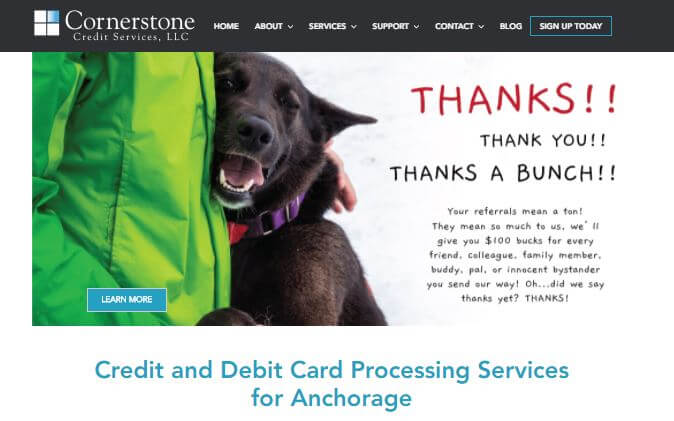
Cornerstone Credit Services has a range of divisions, including payment solutions. The company has an outstanding reputation in Anchorage, Alaska, and it’s the go-to merchant services provider in the region. From a financial marketing perspective, this is gold, but it doesn’t mean no further efforts are required. Cornerstone has actually capitalized on this reputation across their digital assets as well – take this homepage, for example. For one thing, it recognizes the positive impact clients have on the business, and makes them feel special. For another, it encourages them to go ahead and make even more referrals in their personal circles by offering an enticing cash reward.

Ready for another set of quick questions? Here we go. What are your strengths? What are some things you’re already hitting out of the park? How can you use them as part of your financial marketing strategy to grow your business even further? This is important, because it will help you work as efficiently and effectively as possible to reach your goals.

Step three: Nail your value proposition

Once you’ve defined your brand, and you’ve built a strong reputation, you need to work on your value proposition. Catch the attention of your prospective clients and make them an offer they can’t refuse. This is the part where you’ll be encouraging people to click onto your website, guiding them down the path to purchase, and hopefully converting a sale.

Financial marketing example

A key part of this is a strong landing page. Our client, Bookkeeping Alaska, is currently in a growth phase. The owner, Tabitha, asked us to create a landing page to encourage more people to sign up to a special offer that will help them organize their accounts for just $97. She’ll help you set up QuickBooks, start reconciling your statements, start reconciling your transactions, generate system reports, and provide email and phone support along the way.

Landing pages can be really simple. In fact, there’s a recipe for success, because there are a few key touch-points every prospective client will consider in making a decision:

  1. Professionalism of your appearance (i.e. design, layout, text, etc.)
  2. An offer that is immediately very clear and easy to understand
  3. An explanation of what exactly the offer includes (i.e. a list)
  4. Some social proof or a testimonial to encourage trust
  5. An explanation of why your business is a great choice
  6. Several very clear calls to action so they can take next steps

Once you’ve addressed all those points, you’re good to go. When it comes to building effective landing pages, we recommend a tool called Leadpages, which has templates tailored to different industries and different types of offers, making them easy to create. It’s a great way to qualify leads and ensure the people who reach out are a good fit.

Why you need financial marketing services

Once a client has clicked through to your website, the only thing left to do is streamline the path to purchase so it’s easy for them go to ahead and do business with you. Make sure that the next steps are clear, with a strong call to action, and ensure your contact details are prominent so they can get in touch with any questions. It’s that simple.

Want it to be this easy in real life? Give our helpful team a call.

If you’re working in financial services, there’s a fair chance you’re a left-brained person. Along with your aptitude for numbers, and your talent for problem-solving, we’re guessing you also like being organized, you like planning, you like details, and you like executing a well-developed financial marketing strategy. Right?

You like researching the most effective techniques, methodically putting them into place, and watching the leads roll in. Marketing is an interesting sector in that it blends science with art. On one hand, it’s very methodical (and we always tell our clients that consistency is key). On the other, it can be incredibly creative and fun.

In this blog, we’re going to run you through three trends you need to capitalize on to ensure your financial marketing strategy is giving you maximum return on investment. We’ll tell you which bits are about process, and which are about personality, to help you grow.

Ready to get started? Schedule a free consultation.

1. Google Ads: Help clients find your financial services

The first trend you need to capitalize on when it comes to financial marketing is Google Ads. It’s no longer enough to rely on word of mouth, or start a company Facebook page, or build a website without taking further action. These are all great methods, of course, but when it comes to financial marketing, there are simply better ones you can use –like Google Ads.

There are a lot of reasons why Google Ads is amazing, but the main one is simply because it helps people find you when they’re looking for you. BAZINGA. Modern marketing doesn’t get any better than that! Google Ads allows you to target specific keywords, and zero in on your key demographic by selecting things like location, age, income level, and gender.

Let’s put it this way. It makes sense to cast a wide net in the hope of catching a nice fish… unless you have a dependable strategy that will help you catch a trophy king salmon.  You’d take the second option every time, right?

(Well, we would, but then again, our headquarters are based in Anchorage, Alaska, and many members of our team know their way around a fishing boat! Ask us for tips any time!)

The second reason Google Ads is awesome is because the client already knows they need you. They’re actively searching for you, so all you have to do is capture their interest and convince them you’re the best choice to solve their problem. (And let’s face it, people usually engage financial services firms because they have an issue they’re unable to deal with on their own.)

2. Landing pages: Tell your clients why they need you

Google Ads are like a one-two punch. Boom. The client is yours! The first part is setting up the ads; the second is making sure you’re sending clicks somewhere that will seal the deal. This is where landing pages come in. A “landing page” simply refers to the first page a client will see when they visit your website. It’s the first impression you have, so make it count!

When Google Ads first started, it was customary to direct traffic to an existing page on your website, like your home page or services page. More recently, there has been a trend towards directing people to custom sales pages. This is definitely best practice, because it will significantly increase your chances of converting a client and making a sale. So what does a great landing page look like? There are three main points we recommend:

  • A clear offer or deal to show people why they should act now.
  • A value proposition, such as a free download, so people feel like they’re getting value.
  • A number of very clear calls to action to help people know what to do next.

Landing pages don’t have to be long. A really common mistake people make is to stuff landing pages full of key words, thinking that will increase their ranking through SEO (we’re definitely guilty of this too – we’ve mastered our strategy over many years with a lot of trial and error). The trouble is that SEO isn’t really the point of a landing page.

Running Google Ads means you’re already targeting the keywords you need, and because you’re paying per click, you don’t need to worry so much about SEO. Instead, you need to kick your sales brain into gear, and think about the key information a prospective client would want and need to know because deciding to take action.

If in doubt, less is more. Make it snappy. Make it interesting. Make it helpful.

Most of all, make sure the next step is crystal clear and very inviting.

3. Personalization: Let clients know how much you care

Let’s take a moment to recap quickly. Step one was capturing people’s interest with shiny Google Ads. Step two was making them an offer they can’t refuse with a sparkling landing page. Step three is showing the client exactly how important they are to you and reassuring them they’ve made the right choice. We’re not talking champagne and corporate suites at the basketball (although hey, surely no-one would complain about that!).

Here’s a word we know you’ll love: data. Personalization starts with data collection and analysis. You’ll need to figure out exactly who your ideal client is, who is responding to your Google Ads, and who is taking action on your landing page. Are they the same types of people? If not, why not? You may find an audience persona really helpful here to help focus your efforts and ensure you’re targeting the most profitable demographics – i.e. those who are most likely to convert.

Once you know who you’re talking to, tailor your messaging accordingly. Don’t be generic. Target their specific interests. You’ve discovered this group loves football? Great. Make some football puns. Or do they all come from the same neighborhood? Great. Make some local references. Make them feel like you know them, that you understand, and that you can help.

And remember, a follow-up phone call after they take action on a landing page is always a classy touch. Nothing shows a client how important they are like you taking a few minutes out of your day to introduce yourself and thank them for their interest in working with you.

Stay on top of financial marketing trends

Modern marketing moves quickly. It’s an innovative industry, because marketers are always trying new ways to capture people’s attention and make their message heard. Staying on top of the latest trends can feel like a full-time job (and for us, it is! Seriously!).

If you’re running a financial services firm, you’ll have a lot on your plate, so it makes sense to work as efficiently and effectively as possible. You may find it valuable to bring on a marketing partner, who can stay across all the latest trends to ensure you’re capitalizing on the ones most likely to grow your business. If that’s the case, please reach out.

What are you waiting for? Let’s talk business.

The digital revolution has done so much to democratize marketing in the last few years. Now small, local HVAC businesses can compete with bigger companies on a much more equal footing.

Here, we’ll look at three low-cost, and in some cases, free, methods to get huge reach and effective targeting as part of your HVAC marketing strategy.

Prefer to chat to a person? We get it. Give us a call.

Building sales funnels in HVAC marketing

Sales funnels are a widely used marketing technique that you can use to draw in new customers for your business. The basic premise in HVAC marketing is that you start by making people aware of your business and gradually draw them down the levels of the funnel, giving them the information they need, until they decide to become new customers. It’s called a funnel because it starts broadly – i.e. who are you? Then the information gets more specific as they go further along. What’s your full range of services? Then what’s a special offer specific to their needs? Then how do they contact you? The focus narrows until you’ve given them precisely what they need to address the issue they’re having. It’s important to keep this in mind as you design your website and build your strategy from there.

Read more: Capture more qualified leads with landing pages

Awareness is key to good HVAC marketing

Awareness is the first stage in a HVAC marketing funnel. At this point, your main concern is with getting as many people to see your content as possible. You’re trying to convert people from general consumers to prospective leads. These people will remember you next time they need HVAC services. At this stage quantity is as good as quality, you want good coverage, but you also need to make sure that when people read your content or see your ads, they aren’t put off by low quality.

A big part of HVAC marketing is education

Next, you want to be putting out content that answers people’s questions. This shows them the problems they are having, even ones they don’t know they are having, and how you can fix those problems. We like to recommend that you include helpful advice on how people to fix these problems themselves. This breeds goodwill and helps make people trust you so that they remember you as a helpful, trustworthy business next time their A/C unit or furnace needs its annual service.

Read more: Is marketing the new sales?

HVAC marketing relies on engagement

The third stage of the funnel, when it comes to a good HVAC marketing strategy, is engagement. This really requires quality production. Every time someone clicks on one of your ads, or a link in one of your blogs, they will be taken to what we call a “landing page.” It is important that this is just as high quality as the ad or the blog. The purpose of all these ads, blogs, landing pages, and so on, is to get people to reach out to them, to walk into your metaphorical showroom.

The best part of HVAC marketing is conversion

Finally, we come to the thin end of the funnel, conversion. At this point, people are actively coming to you. They know who you are, they know what services you provide, and they have a good impression of your business. Now that, you’ve got them coming to you, you need to sell to them. Let’s continue our showroom metaphor. They want to buy a product that you sell or use a service that you provide. What you have to do is prove to them that they want to buy from your business, not your competitor. At this point, you’re no longer really doing digital marketing, but rather you’ve transitioned into sales.

Ready to get started? Schedule a free consultation.

Social media is key to HVAC marketing

Social media is another incredibly powerful HVAC marketing tool that has made the job of small companies easier than ever before. Because platforms like Facebook have such huge reach, with more than 2/3 Americans using it, you can market directly to your most likely buyers. It’s an essential element of every strategy, because unlike the broad funnel of your website, waiting to catch interested customers, you can use social media more like the nozzle of a vacuum cleaner.

The advantage of social media, and advertising platforms like Google, is targeting. Social media platforms gather huge amounts of data about their users which allow them to model those people really accurately. This means that you can target ads to people and be confident that they are more likely to succeed than traditional ads. The real advantage with social media is that you can do this, while still advertising to huge numbers of people, which makes your sales funnel very effective.

Social media is useful in other respects as well. It allows you to create a community following around your brand, with real person-to-person interaction and gives your customers a direct line to your business for reviews. Some may see this as a benefit only for the customer, but your business can benefit as well, as long as this is done right. When you post content on your Facebook page, you open yourself up to the whole world, and anyone can say anything. This means that any negative reviews you receive can be responded to directly. When doing this, it’s important to do it well though! You have an opportunity to turn a negative review into a positive with a well-reasoned, polite response. We often find that these actually give a better impression of a business than great reviews alone.

Read more: Is your social media producing results?

Blogging can boost HVAC marketing efforts

We briefly mentioned blogging in our sales funnel walkthrough, and here we’ll discuss how to make sure your blogs have maximum effect. Blogging may not be an obvious HVAC marketing strategy, but it’s essentially a method to game Google’s search algorithms, known as Search Engine Optimization.

Whenever someone searches for something on Google, the search engine searches through everything on the internet to bring you the most relevant results. It works out what is relevant based on various criteria some of which we’ll list here, along with the way you can meet those criteria:

  • Relevance: Google calculates relevance based on the amount of time users spend on the search results provided for a given search term. If someone searches “HVAC near me” and they click the first result and realise it isn’t what they’re looking for, they click the back button quickly and Google interprets this as the page having low relevance. You, therefore, need to make sure that your blogs are relevant to the title and keywords you’re using.
  • Questions: You’re probably aware that Google searches are often used to answer questions. A great strategy for blog writing is to find out what questions are being asked, using services like Answer The Public, which allows you to find out what the most common questions are for certain keywords. Just type in the name of service or product you want to sell, find out what people want to know about it, and answer that question. Make sure you link to a page where people can either buy the product online or a contact form so they can get in touch.
  • Backlinks: Google uses links on webpages as a sort of review system. If someone links to your site, it means they think it is good. However, getting other websites to link to yours can be challenging, so we use the practice known as backlinking. This involves linking between pages on your own website, to accrue multiple “recommendations” of your own content.

Ready to develop your strategy? Call our friendly team.

Social media is the perfect tool for mental health marketing. The wide variety of platforms means that you can target your preferred audience, use the whole range of digital media, and build brand loyalty. Even better, you can do most of this for free! In this post, we’ll explain our five top tips for making sure your social media presence is as good as it can be.

Already know what you need? Give us a call.

1. Choose your social media platform(s)

There are so many social media platforms these days that choosing which one to use for your mental health marketing strategy can seem like a daunting task. They are all different, and the demographics that use them mean the differences are important. Ultimately, the platform you choose will inform the audience you are able to reach.

For example, Facebook is still the biggest platform around, and it has loads of useful features for businesses, but its user base is getting older. If you want to target a millennial audience for your mental health practice, you might do better on Instagram. If you want to target even younger audiences, you’ll want to be looking at platforms like TikTok.  The challenge with the youngest social users is keeping up with whatever platform is fashionable right now!

The audience is not the only factor to consider, however. Different platforms also lend themselves better to certain types of content. In some cases this is obvious – for example, YouTube is for videos – but in others, it might be less clear. Instagram is for photos, right? Well, it can also be a really good platform for short video. Meanwhile, LinkedIn, with its focus on B2B, tends to be used more for text than other platforms. This is important to consider when trying to place your marketing efforts.

Read more: Telemedicine is booming in mental health

2. Mental health marketing needs consistency

This is something that sounds obvious, but which many people overlook. If you want your mental health practice to have a successful social media presence, you need content. Just creating an account won’t do anything. You need to be posting at least weekly, and we’d suggest more regularly if you can. The real advantage of digital marketing has over traditional marketing is that it’s so easy to put out large amounts of content to lots of people. Unfortunately for you, everyone else is doing this too. The more they put out, the more you have to put out in order to just be noticed. Social media may have democratized mental health marketing, but it’s also increased the work you have to do to keep up.

So, if treating social media like a billboard or newspaper won’t do, then what will? Well, as we said above, post content! Post it as often as you can, post every time you write a blog on your website, post every time you offer a new service, post every time you change something about the way you practice, post every time you attend a mental health conference, or a new study comes out that changes the way you work. You need to be putting content out there if you want this to be worthwhile.

Read more: 3 things to know about Google Ads.

3. Community building on social media

We’ve got quantity out of the way, now for the quality. What we call “community building” in mental health marketing is really just a different way of saying building brand loyalty. The great advantage of social media is that you can build brand loyalty in people who haven’t even visited your mental health practice. This means that if in the future those people do find themselves in need of mental health services, they’ll already have a preferred provider in mind, you!

There are many ways of building a community online, and each successful business has its own. Here, we’ll just give a few tips that go a long way. Obviously, the first is in what you post. Your content should be friendly, human, and show people that your team is made of real people, not just a corporate account run by some faceless person in an office block. Just as important is that way you interact with people who comment on your posts. Social media posts aren’t just “fire and forget” marketing; they’re two-way. If you reply, you can build rapport with the comments, and everyone else who stops to read.

The way you reply is possibly even more important. Having a good in-person reputation is hard when your social media is badly managed. If people are posting criticisms on your platforms, you need to be able to respond politely. It may sound obvious, but it’s not uncommon to see businesses respond to negative comments badly, and it can be more off-putting than the original comment.

Remember the golden rule of social media: everyone can read what you write!

Looking to maximize your impact? We can help.

4. Branding is key to mental health marketing

This is related to our previous section but goes a little further. Not only is it important to remain courteous, but also to keep the tone of your posts consistent with the mental health service you’re trying to sell. There is a certain tone of voice that is appropriate when posting about children’s services, but a very different tone might be needed when talking about crisis prevention services.

It all comes back to your brand. Who are you? Why are you in business? What matters to you and why? What is your purpose? Figuring this out right at the beginning means your messaging will be consistent across all of your social platforms, as well as the way you treat your patients in real life. Consistency is essential in mental health marketing because it helps people get to know you, so they know what to expect when they engage your services, and they can feel confident working with you.

Read more: What makes a good mission statement?

5. Mental health marketing needs visuals

Visual marketing has become really important in mental health marketing. This isn’t really news, because images have been used in marketing for as long as marketing has existed, but we’ve never before had the ability to include video quite so easily. Previously, you’d have to pay big bucks to produce television commercials, but now you can just pull out your phone and do a Facebook live. This is a great way to let people meet you, see your practice, and invited them to come and visit.

Video is a great way to convey information. Humans absorb and retain data best when they are able to hear and see someone telling them, so this is the best way to get your message across – second only to talking to someone face-to-face. Video is also much more friendly, and less intimidating, than a wall of text. If you’re interested, you can learn more about video marketing here.

Ready for a marketing partner? Schedule a free consultation.

You’ve probably seen the term “sales funnel” quite a lot as you’ve been researching digital marketing online. They can be extremely powerful when you’re trying to convert leads, but how can you apply a sales funnel to your dental marketing strategy? That’s a really good question.

Sales funnels works as you’d expect, by collecting as many people as possible at the wide end, and gradually drawing them down the levels of your funnel until they become paying patients at the bottom. The number of people at each stage will reduce as they progress through the funnel, until you only have qualified leads. The way you set up your funnel is important, so here’s a step-by-step guide.

Ready to talk sales? Ask our experts today.

Dental marketing starts with awareness

Awareness is the first stage of every digital sales funnel. This is where people become prospective patients, transitioning from never having heard of your dental practice, to becoming aware of it. This is also the stage at which the person starts to learn how you can help with problems they’re having.

The best dental marketing strategy here is to generate awareness is through content. At this stage, you want lots of people to see what you’re putting out. This maximizes the number of people in the funnel and increases the number of people making it all the way through. This is a case of quantity AND quality – obviously, the content has to be good enough that people actually read or watch it, but you need to make sure you don’t spend too much time making it, and too little working on the next piece.

So, what kind of content you be putting out to raise awareness of your dental practice?

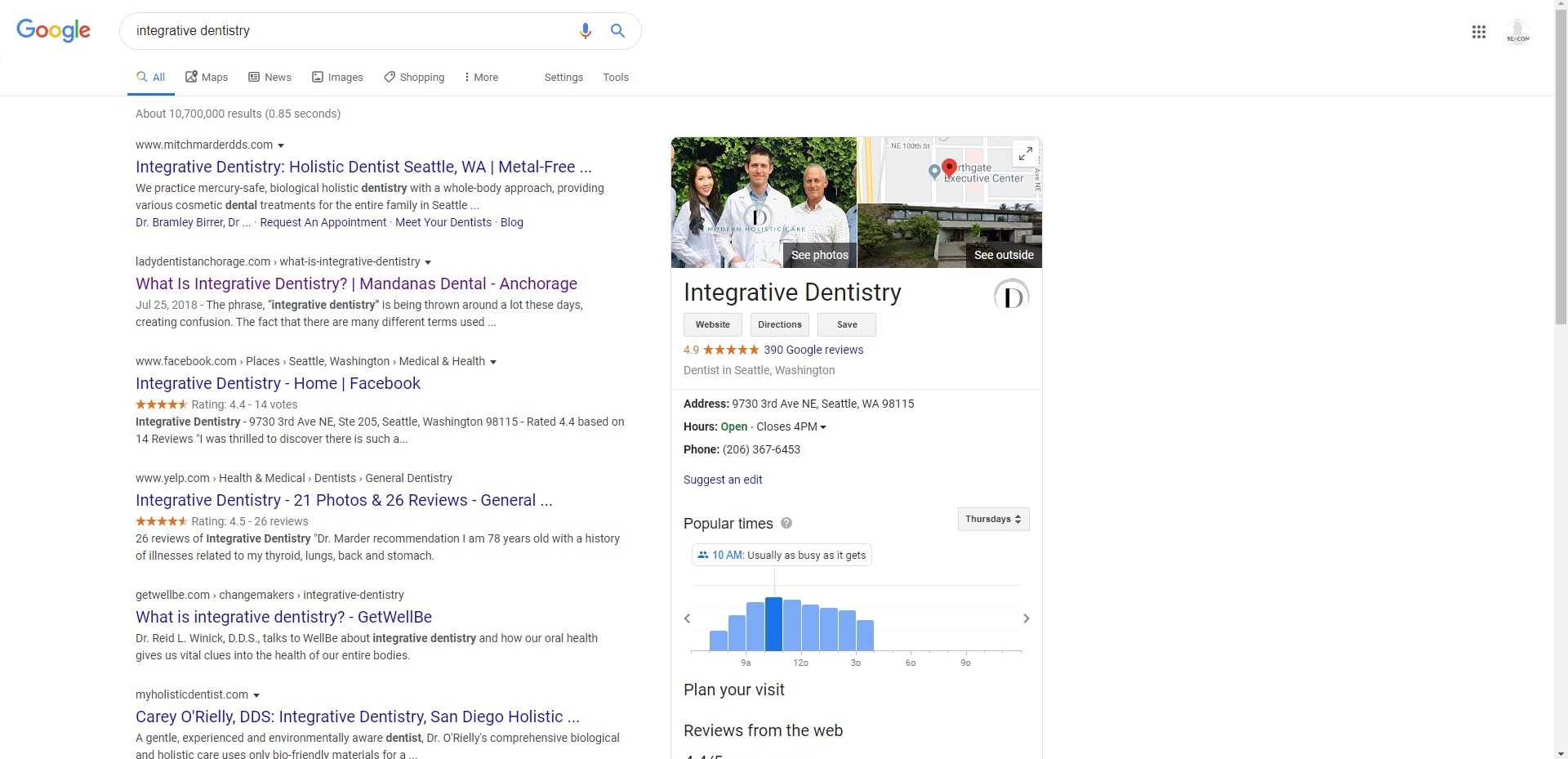
The truth is just a 400-600 word piece about a topic people are searching can increase the chances of people finding your business. Take our client, Dr. Mandanas, whose integrative dental practice is based in Anchorage, Alaska. We write blogs for her dental practice every month and now we have our blog on the top of the Google results page for the search term “integrative dentistry.”

Dental Marketing

You can increase your chances of reaching the top-ranked spots on Google search by practicing Search Engine Optimization, which we explain in detail here. It’s a really neat way to take your dental marketing strategy to the next level. You should also note that in addition to publishing on your website, you can boost the reach of your blogs through Google Ads, Facebook ads, and social media.

Want to phone a friend? We’re here to help.

Education is the key to dental marketing

The next level of the funnel is education. This is for those people who clicked on one of your ads, navigated more of your website after reading your blog, or clicked on a link in a Facebook post. The people who click on a link on social media or an ad need to be sent to dedicated “landing pages,” which are essentially sales pages that give people all the information they need to sign on.

For example, if you’re advertising children’s braces, your ad and landing page should focus on the topic. The landing page should give some more information about the braces you offer, the problems you can fix with them, and how to get in touch with you so that they can learn more. It should be fact-based and persuasive – getting this right is essential to your dental marketing strategy.

Alternatively, if you wrote a blog post about regular cleanings and their importance in staving off periodontal disease, you could then include a link to the page of your website where people can schedule an appointment to have a check-up and cleaning.

Read more: 5 genius ideas to grow your dental practice

Dental marketing leads to engagement

The third level of the sales funnel is where prospects become leads. People in your community are aware of your dental practice, they know they services you provide, they’ve clicked through to your website, and now they need to be converted into leads. The best way to convert these people is by having them reach out to you and schedule a consultation, or to ask about your services and costs.

The question, then, is how to get these people to get in touch?

Your landing pages really need to be on point. You need to be active on social media. You need to run Google Ads for key terms people will search when they have an issue you can address. That way, you’re staying front of mind and making it as easy as possible for them to choose your practice. That way, when they’re interested enough to pick up the phone or fill out a contact form on your website, it will be an easy decision and you’ll be waiting to welcome them into your office.

Although this is a very exciting stage, we’re not done yet.

This is where you cross from dental marketing to sales. The prospective patient is now interested enough in your dental practice that they have actively got in touch with you, but if you can’t close the deal all that work will have been wasted. We call this process “conversion”, as you are converting a person from a prospective patient into an actual patient.

Need help refining your landing pages? Contact us.

Converting patients with dental marketing

Conversion may be more of an art than a science. It’s important to remember that people probably aren’t just looking at your practice. If they’re actively looking for a dentist it’s likely they’re dissatisfied with their current provider, or they have a problem. If it’s the latter case, they are likely to be looking with a sense of urgency and will be looking for a solution ASAP. Whichever of the practices they are researching is able to provide that information first is likely to convert that prospect into a patient.

According to revenue acceleration company Xant, half of prospective patients choose the company that reaches out first. Among the reasons for this are a perception that your practice is well organized, professional, eager to help, and easy to find. Those who do it well are likely to convert.

Read more: Step-by-step orthodontics marketing plan

Dental marketing needs a target

We talked at the start about the way sales funnels grab as many people as possible with a wide opening, and gradually draw people down to become patients as they pass each level of your dental marketing strategy. However, there are tools available that make this even more efficient.

The rise of targeted advertising on platforms such as Facebook, and across the entire web thanks to Google, means that you can use your funnel a bit more like the nozzle of a vacuum cleaner. By targeting your ads based on Facebook or Google’s prediction models, you can make sure that your ads are only seen by people who are likely to make their way all the way through the process. This may seem as though your numbers will be reduced, but due to the vast reach of platforms like Google and Facebook, you can still reach large numbers of people. More importantly, you’ll reach the right ones.

We hope you find this guide helpful in creating your own sales funnel. This is a great time to re-evaluate your dental marketing strategy as many people look to start returning to regular life, although now with a heightened sense of hygiene and cleanliness. Not only is this a time to welcome your regular patients back, but you can also seize the opportunity to increase your market share.

Ready to get started? Schedule a free consultation.

It’s time for people to come back to the dentist after lockdown, which means now is a great time to be marketing your dental practice. This is a great opportunity to start gaining market share, as well as welcoming back your own regular patients. If you want to make the most of this period, you’re going to need a killer marketing strategy that makes use of all the tools available to you. Keep reading for our top four dental marketing tips.

Prefer to talk it through in person? Give us a call.

1. Dental marketing starts with a website

No matter what your dental marketing plan entails, sooner or later patients will be looking at your website. A few years ago, an amateur could put together a website and it didn’t matter that much what it looked like. Nowadays, however, so many people have well-designed sites that anything less can reflect badly on your dental practice. It’s easy to see why. If you’re looking for a dentist to take care of your teeth, you want someone who gives a sense of competence and professionalism in every aspect of their business. A well-designed website, with a clear list of services and costs, is a necessity if you want potential patients to feel as though they can trust you to take care of their oral health.

Your website can also show the human side to your dental practice. Many people are wary of visiting a dentist, and humanizing the process can alleviate some of their fears. Short biographies of your staff members, lots of pictures of the practice, and testimonies from current patients are all dental marketing essentials. They can all help to make the dentist seem much less daunting.

A great website will be the anchor for your entire dental marketing strategy.  All of your social media presence, advertisements, and physical marketing will point people to your website. It should be easy for visitors to find your location, your contact details, and your services and costs. This allows them to decide that you’re the dental practice they want to visit and make the necessary appointments.

Read more: Managing online reviews in dental marketing

2. Community building in dental marketing

Social media is the next most important dental marketing tool. It has such a huge reach that not using it is a significant lost opportunity. Social media allows you to produce ads which can be targeted to specific audiences. This targeting can be incredibly specific due to the amount of data people willingly give and the inferences that these companies are able to draw from users’ activity. We’ve written before about how Facebook advertising yields results (you can read that here).

Here, we want to focus on the organic side of social media. When we talk about “organic” on social media, we’re referring to the posts you make on your own profile, rather than paid ads. These posts are visible to people who follow your page, as well people tagged in the comments. This kind of post may not have the same kind of reach as an ad, but it has a different relationship with the people who see it, because it feels more genuine – it’s a modern form of word-of-mouth advertising. It’s easy to present the culture of your dental practice, perhaps with slightly less “polished” visuals, but they let people interact with your practice on a personal level, which builds a community. Dental marketing in this way builds a form a form of brand loyalty, where patients feel that they actually know you.

We’ll develop a step-by-step guide for you. Contact us now.

3. Dental marketing with Google My Business

Google My Business is a tool that we are recommending to our clients more and more as we see really impressive results. You’ve probably come across it before. When you search for a restaurant or store, you’ll see a box on the right-hand side of your Google Search results page. It can include images, a link to the website, and interactive phone links for mobile users.

We recommend it for the same reason we recommend a professional website: it’s becoming standard, which means not having one can make your dental practice seem less reputable.  If all the big-name businesses have Google My Business then not having one makes you seem like a small, slightly unofficial business, and no-one wants to visit an unofficial dentist.

The good news is that it’s is really easy to set up. In fact, we’ve written a detailed guide on setting up your listing here – it’s as simple as finding your listing on Google and claiming it. You’ll want to do this as soon as you can, because the process is so simple that anyone can claim a listing. At this stage, there’s actually nothing that can stop someone else from claiming yours, which isn’t ideal.

Case studies: Grow your practice with these bold strategies

4. Online reviews in dental marketing

Google My Business allows us to slide neatly into our next tip, online reviews. Reviews are integrated into your listing, so anyone who searches for your dental practice can see what others think of you. This is really important. If your practice is well-rated, this will obviously inspire confidence in prospective patients. On the other hand, dentistry is a field where people are already nervous, and the perceived potential for harm is large. In practice, this means that your reviews are going to have a much more significant impact than other types of businesses, such as stores or coffee shops.

The best way to make sure you get good reviews is to give good service, but there are other tricks to maximize your score. You may have heard of a concept called “volunteer bias.” This is what happens when people are voluntarily able to review products. Those who had an average experience don’t put in the time to review, so the aggregate score represents only those who had either a bad experience or a very good experience. As a result, negative reviews can have a disproportionate effect. You can get around this by actively asking people to review your business. This is a fine line to tread, because being too pushy can lead to people be put off and giving a worse review, however, when it’s done well, it can fill in some of that space between the very good and the bad, which improves your score. It also increases the numbers of reviews, so any single bad review is much less noticeable.

Another good strategy for reducing the impact of bad reviews is to reply to them. A well-reasoned, polite response can often turn a bad review into a positive – read this post to learn more.

Worried about your reviews? We can help!

Bonus tip: Using video in dental marketing

Okay, okay, we promised four tips – but here’s one extra. We’ve been writing a lot about video lately. It’s dramatically increased in popularity with the increased performance of mobile devices, and it’s a great way to connect with customers online. For example, it’s an excellent way to cram a lot of information into a format that takes little effort to absorb, and it’s easy to maintain attention.

Not only is video great for information transfer, but it’s also really great for building rapport as it allows you to present a human face to potential patients. As we mentioned before, this is especially important for dental practices as it helps remove some of the apprehension that people may feel. It also gives you a great opportunity to let people see your practice and to talk about offers.

We hope you’ve found this list of our top tips helpful, if you’re interested in learning more about the digital marketing strategies we use, check out our other blog posts on marketing for orthodontics.

Need a marketing partner? We’d love to help.

The world is very different right now than it was six months ago. The events of this year have caused a lot of change in the way people live and do business. Businesses that rely on face-to-face interaction, such as dental practices, have been hit particularly hard. Even now, as the market is starting to open up again, there will be lasting changes. It makes sense, then, that your dental marketing strategy changes accordingly.

Need personalized advice? Schedule a free consultation.

Social strategy is now king in dental marketing

One of the most important lessons learned from the lockdown period is that dental practices who interact with their customers on a real, human level do best. That means social media should be at the core of your dental marketing strategy, because it allows direct contact for reviews, criticism, and complements. This lets your patients feel like they’re really talking to a person and that their comments and concerns are being heard.

Posting on social media falls into two categories: ads and organics.

Ads are exactly what you think: images or short videos that grab attention and hopefully draw people to your social profile or website. Social media advertising is incredibly powerful. Platforms such as Facebook collect lots of data about their users which allows them to build detailed profiles about those people’s personalities, likes, and dislikes. Also, you are able to target your ads, rather than just scattering them out and hoping that potential leads see them, as you might with traditional media such as newspaper or radio ads.

Because of all the data social media companies collect, you can be really specific about the people you want to target. This type of advertising is called “targeted advertising” and it is almost the sole source of revenue for Facebook, Google, and other large tech companies that offer free services.

Organic posts are posted directly to your account feed, and while there is no cost attached to these, people won’t see them unless they visit your account or follow you. The advantage of organic posting is that it has a way more personal feel. People who see these posts are more likely to feel like they are seeing something personal.

This is where our next point comes in.

Read more: Step-by-step orthodontics marketing plan

Dental marketing needs constant communication

Because so many people have been exposed to reduced, and often uncomfortably low, levels of social interaction over the last few months, it is more important than ever to show a friendly, welcoming face in your dental marketing plan. Social media provides an amazing way to do this by allowing you to communicate directly with potential new patients. However, just posting once or twice won’t be enough to maintain this image.

The more you communicate with your followers, and the friends they share your posts with, the more this impression of personability comes through. If you’re able to post daily, both existing and potential patients will feel as if they’ve got to know you. Not only does this give them cause to trust you when they are looking to return to the dentist, but also keeps you in the back of their minds, so that they think of you when they do decide it’s time for their next appointment. This is key to your dental marketing success.

Applying the methods you use for your organic posts to your ads is another great way to give the impression of interacting with a real person. When people see a clean-cut, professional ad, with all the perfect imagery and color, it may feel just a little distant and corporate. To someone who hasn’t seen their family for four months, or who hasn’t left their apartment in a week, a simple video of your staff warmly expressing how much they’re looking forward to welcoming patients back to your practice can go a long way.

Case studies: Grow your practice with a bold plan

Video is perfect for dental marketing right now

Speaking of video… video is one of the best tools in your dental marketing toolbox when it comes to making things personal. Someone who really understands the power of this strategy is Gary Vaynerchuk. He has mastered the use of his smartphone camera to give the impression that he is talking directly to the viewer, almost like a personal video call. This works especially well on social media because of how scalable it is. He can have a “1-to-1” conversation with millions of people at once. (We’ve discussed Gary and how he creates such successful content before – if you want to learn more about video production, check out this blog). This style may not suit you or your dental marketing plan, but using video of your staff, and even customers if they are happy to help, gives a sense of honesty when you make claims about how great your business is. A short text post saying that you’re offering a discount for new clients is nowhere near as impactful as a short video of a patient who had a great experience.

The sense of personal service that you can give with visual media is complemented by the brain’s ability to digest imagery better than text, and to remember it for longer. In fact, this article from 2012 found that users are more than 27 times as likely to click on a video ad than a standard banner ad! From presenting information faster than text, to allowing people to take in non-verbal communication, there’s a reason why the most popular social media platforms are those that include a large amount of video, including Facebook, YouTube, and Instagram.

Read more: Managing online reviews in dental marketing

Dental marketing needs reassurance first

As people start heading back to the dentist after lockdown, many may be concerned about the continuing risk of infection. Your marketing is an excellent way to reassure your existing and potential new patients that you are exercising the highest standards of safety and infection control. This is something that won’t disappear just because the lockdown ends either. It’s highly likely that the impact of this period will be felt for at least the next year and that people’s awareness of infectious disease will remain at a heightened level for a long time.

Again, video will prove an important tool in showing how seriously you’re taking the safety of your dental patients. Showing the preparations you’ve made and precautions you’ve taken, while also reassuring people that they can still expect a warm, personal service behind the mask, will make sure that people feel confident to pay you a visit.

Need some help? Ask our dental marketing experts today.